The Cheapest Commercial Ping Pong Table Quote I Ever Got Cost Us $9,400
-
The Cheapest Commercial Ping Pong Table Quote I Ever Got Cost Us $9,400
-
The order that taught me the lesson
-
Why "upfront pricing" isn't just a nice-to-have
-
The counterintuitive part: I now pay closer attention when a quote looks expensive
-
"But sometimes the cheaper quote really is cheaper"
-
What I'd tell you if you're sourcing right now
The Cheapest Commercial Ping Pong Table Quote I Ever Got Cost Us $9,400
I'm going to say something that will annoy a lot of procurement people: the lowest quoted price on a commercial ping pong table order is almost never the lowest actual cost.
Not "often." Not "sometimes." Almost never. And I say that as someone who spent roughly three years learning it the expensive way, and about $9,400 in the process.
I've handled sourcing for commercial recreation equipment since 2018. Over that stretch I've personally signed off on mistakes totaling somewhere around $40,000 in wasted budget across maybe a dozen incidents worth documenting. Some were mine. Some were because I trusted a quote I shouldn't have. Now I maintain our team's vendor evaluation checklist so nobody on my side repeats them.
The single most persistent pattern? Low quote, high invoice. And ping pong table sourcing is where I first learned it, back in Q2 2019.
The order that taught me the lesson
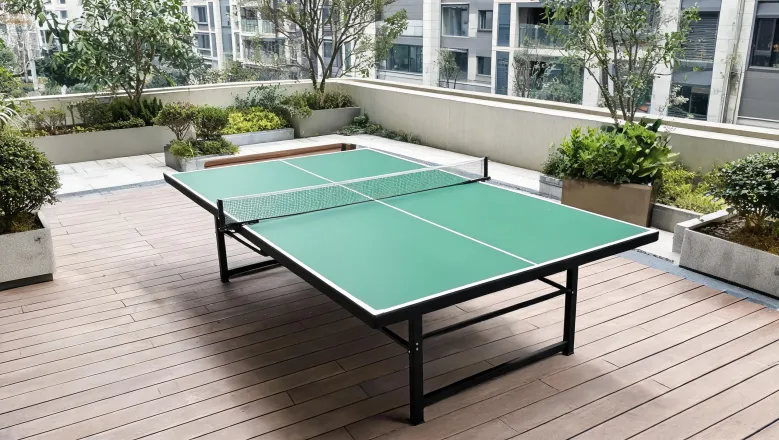
We were sourcing 180 commercial outdoor ping pong tables for a hotel group's resort expansion. Three quotes back. Two suppliers landed around $340–$360 per unit FOB. The third came in at $268.
That's roughly a 25% spread. On the surface, easy decision. I'm not going to pretend I didn't think, "well, that's a lot of money saved." Because I did. I literally wrote "saves ~$13,000 vs next lowest" in my comparison notes.
What I didn't do was get the packing spec confirmed in writing before signing off on the PO. I knew I should have. But I thought, "we've run this route before, what are the odds?" Well — the odds caught up with me at the port, when the standard cartons failed inspection and required repacking at our cost.
That was just the first surprise. Here's what the invoice actually worked out to per unit once the order shipped:
- Base price: $268
- "Export packing" (crate upgrade, because standard cartons were deemed insufficient for a 40HQ container): +$22/unit
- Fumigation certificate: +$3.40/unit
- Third-party inspection (arranged by the supplier, billed to us): +$8/unit
- Port congestion surcharge: +$14/unit
- Missing accessories kit (nets, brackets, and wrenches were listed as "optional"): +$19/unit
Final landed unit cost: roughly $334 before freight. Before duties. So the $268 quote was never $268 — it was $334, which put it basically at parity with the supplier I thought I'd saved money against. Except that supplier had quoted everything included, in writing, with no surcharge language anywhere in the document.
I did the math later. On 180 units, the gap between what I thought I'd save and what I actually saved was about $9,400 in the wrong direction. And we lost three weeks going back and forth on the accessories dispute.
The lesson wasn't "don't trust overseas manufacturers" — that's not true, and honestly, plenty of them quote straight. The lesson was that I compared unit prices instead of total landed costs. Those are not the same number, and the difference is where the budget goes to die.
Why "upfront pricing" isn't just a nice-to-have
Here's what I now believe, with the confidence of someone who has been on the wrong side of this equation: transparent pricing is a signal of operational competence, not just honesty.
When a ping pong supplier gives you a number that includes packing, port charges, inspection, and accessory kits, it usually means they either (a) know their own cost structure well enough to price the whole thing, or (b) have done enough volume that they've stopped treating fees as a revenue lever. Both of those are good signs.
When a quote is suspiciously low, it's typically one of three things:
- They haven't priced the shipping logistics yet and will surprise you later ("oh, that's ex-works, not FOB")
- The spec is quietly downgraded somewhere — thinner top, lower-grade frame, fewer accessories
- They're relying on surcharges as margin, and the base quote is a foot-in-the-door number
None of these are malicious, necessarily. Some are just sloppy. But from my side of the table, the outcome is identical: a number that moves after you've committed.
For what it's worth, the same logic applies to wholesale ping pong balls. We order them alongside tables — 5,000+ units per run sometimes — and the quote with clear material specs (ABS vs. EPDM, thickness tolerances, bounce ratings) tends to be the one that doesn't shift mid-production.
The counterintuitive part: I now pay closer attention when a quote looks expensive
This is the part that took me longest to internalize.
A vendor who quotes $360 when competitors are quoting $290 is either overcharging or including things the others aren't. In my experience, it's usually the second.
I've learned to ask one specific question before any price comparison: "What's NOT included in this quote?"
That question has saved us more money than any negotiation tactic I know. Because the answer tells you whether you're comparing apples to apples or apples to something that will become apples at additional cost.
Example: last year (Q3 2024), we got quotes on a run of custom ping pong tables for a corporate campus. One at $520/unit. Another at $465. The $465 quote had per-line exclusions for "logo silk screening setup," "custom wood samples," and "bracing for outdoor exposure." Those three items, once priced, pushed it to $512. The $520 quote included all of them, with a stated tolerance for outdoor fastener ratings.
We went with the higher-looking quote. Total saved on the project: around $1,600 — mostly because we didn't have to chase three separate surprise change orders mid-production.
One quick spec note that connects to this: if you're buying for tournament-adjacent environments, ITTF equipment rules (current version as of 2024) specify a minimum top thickness of 18mm. Worth asking your supplier for the actual spec number instead of accepting "commercial grade" at face value. I assumed "commercial grade" meant the same thing to every ping pong table manufacturer. Didn't verify. Turned out one supplier's "commercial" was a 15mm top and another's was 18mm — and most of the price gap between the two quotes came down to board thickness, not service or margin.
"But sometimes the cheaper quote really is cheaper"
Yeah. I get that objection, and to be fair, it's true sometimes.
If you're buying 20 folding ping pong tables for an office rec room — non-commercial, indoor, standard spec — the difference between a "complete" quote and an "add-ons" quote might be $4 per unit. In that case, optimize all you want. The transparency premium doesn't matter much at that scale.
Where it starts to matter is commercial and outdoor orders, especially custom work. Any time the order involves:
- Custom dimensions, branding, or finish specs
- Outdoor-rated materials and hardware
- Container-level volumes with packing requirements
- Multi-stage production with inspection checkpoints
…the probability of hidden variable costs goes way up. And the quote that looks expensive at the top is usually the one that stays flat.
I'll concede one thing: not every "all-inclusive" quote is honest either. Some vendors pad the complete quote with items you don't need. The check there is to ask for a line-item breakdown and compare against what you actually requested. If something in the breakdown looks irrelevant, ask why it's there. A good supplier will either remove it or explain it. A bad one gets weird about it.
What I'd tell you if you're sourcing right now
I keep coming back to the same thing I've now told three different colleagues: stop comparing quoted prices. Compare landed cost scenarios.
That means building the follow-up questions into your evaluation before you even get the first quote back. Ask about packing, port charges, inspection fees, accessory kits, and any surcharge language. Get it in writing. If someone pushes back on listing their own fees, that's information too.
For what it's worth, this is the approach I use now for every category we source — not just ping pong tables. It works because it forces the comparison onto the ground where it actually matters.
And a small note on timing: the pricing examples above are from our team's 2024–2025 quote records. Freight rates and material costs move fast — I was paying very different numbers in 2021, and I'll probably be paying different ones next year. Verify current market rates before you anchor your budget to anything in this article.
Bottom line: the quote that makes you slightly uncomfortable at 8am on a Tuesday is usually the one that lets you sleep on Wednesday. The one that seems too good to be true usually is — you just find out at the invoice stage instead of the quotation stage.
Trust me on this one. I paid $9,400 to learn it.