Why Your Commercial Outdoor Ping Pong Table Quote Doesn't Match What Arrives
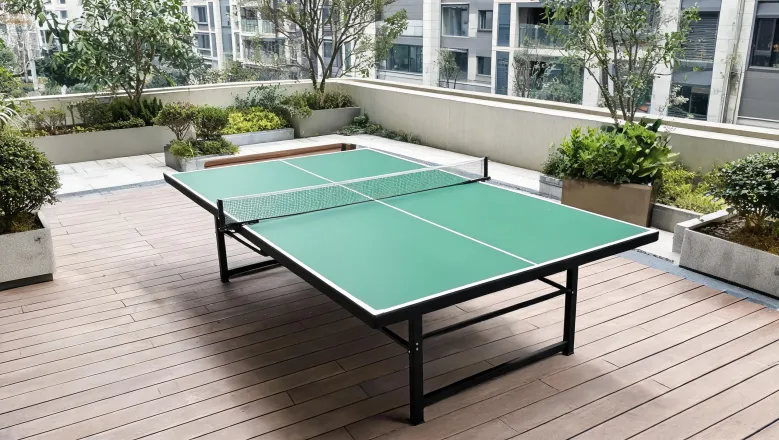
The Surface Problem With Commercial Outdoor Ping Pong Tables
In 2023, we took delivery of 40 commercial outdoor ping pong tables from a new supplier. The paperwork said everything was correct. 25mm aluminum playing surface, powder-coated frame, UV-resistant topcoat. Then the warehouse team unwrapped the first pallet.
The playing surface had a visible wave across it—maybe 2mm of deflection when you ran a hand across the middle. Not catastrophic in absolute terms. Enough that a ball didn't sit flat on a level-test. Enough that a buyer walking through the gym would notice before they ever played a point.
We rejected all 40 units. The supplier redid them at their own cost. But that cost was already baked into our timeline: eight weeks gone, a school district's opening delayed, and one client relationship that now requires video inspection on every order.
Why am I telling you this? Because when most B2B buyers go looking for a ping pong supplier, they think the problem is price, lead time, or whether the table will survive a rainy season. Those are real concerns. But they're not the thing that actually bites.
The Problem Isn't the Quote — It's the Definition of 'Commercial'
From the outside, comparing commercial ping pong table quotes looks like a straightforward exercise: line up the specs, find the lowest number that meets them, place the order. The reality is that two suppliers can write 'commercial-grade 25mm surface' on the same quote and mean two different products.
This is what I call spec drift. The document looks identical. The physical item doesn't.
Where spec drift hides
Three places, in my experience.
Surface thickness. A 25mm table and a 22mm table look the same in a catalog photo. They don't play the same. They also don't weigh the same, which matters when you're installing 40 units across a rec center and the anchor requirements change.
Frame gauge. Suppliers will list 'steel frame' or 'powder-coated aluminum frame' without a gauge. A 1.5mm wall tube and a 2.0mm wall tube have different failure points under load—say, when a 250-pound adult leans on the end for a selfie at a corporate event.
Weather resistance. This one gets hand-waved the most. 'Weatherproof' and 'weather-resistant' are not the same claim. Neither is 'outdoor-rated' without a stated exposure test. If your supplier can't tell you the UV exposure standard or the humidity cycle they test under, 'outdoor' is a marketing word, not a spec.
And it gets worse with 'custom'
When buyers ask about a custom ping pong table, they often mean one of two very different things. One buyer means custom branding—logo on the surface, custom edge tape, branded packaging. Another means structural custom: non-standard length for a narrow room, ADA-compliant height, or a folding mechanism that fits a specific storage closet.
If you don't spell out which one you mean, you get the first one. Every time. Because surface printing is cheap and structural tooling is not.
If I remember correctly, we had a buyer request 'custom dimensions' on a 12-table order once. The supplier delivered 12 standard tables with a custom paint color. Technically true to the word. Not remotely what the buyer needed.
What Spec Drift Actually Costs
Here's the thing: the quote is rarely the biggest line item. The costs that come after acceptance are.
Let me run through what a single rejected batch cost us that year, on the 40-unit order.
- Outbound freight both ways. Roughly $4,200 for the returns and the replacement shipment.
- Warehouse holding. Two extra months of storage while the redo was in production—about $1,800 in space we had to rent.
- Client penalty clause. We owed the school district $6,500 for the delivery miss on their opening date. That was in the contract we signed enthusiastically in February.
- Sales team time. Hard to price, but two reps spent a combined five weeks managing the fallout instead of closing new accounts.
Call it $12,500 in soft costs on a $28,000 order. That's a 45% hidden premium. The supplier's original quote was 6% cheaper than the runner-up. Six percent.
Looking back, I should have paid for the 6% gap and gone with the vendor who sent a sample table to our warehouse before the PO. At the time, the savings felt like a competency flex. It wasn't.
Wholesale ping pong balls aren't exempt
Same dynamic, smaller numbers. When you order wholesale ping pong balls for a commercial venue or a school program, star ratings (1-star, 2-star, 3-star) get used loosely. A '3-star' ball from one supplier can feel noticeably harder than a '3-star' from another. If you're buying 10,000 balls for a tournament season, that difference shows up in player complaints and re-orders. We learned to request a 20-ball sample bag from three suppliers and test bounce consistency in-house before committing.
How to Source Without Getting Burned (Short Version)
I could write another thousand words on this, but the fix is honestly shorter than the problem.
One: get the spec sheet in numbers. Surface thickness in millimeters, not 'commercial-grade.' Frame wall thickness in millimeters. UV exposure standard, or the test condition the supplier actually runs. If they can't produce it, that's your answer.
Two: request a physical sample or a video walkthrough. Not a catalog photo. A video of the actual table you'll receive—bounce test, frame close-up, edge seal. For orders over a certain size, this isn't a courtesy, it's a standard procurement step.
Three: separate the two meanings of custom in writing. If you mean structural modification, say 'non-standard dimensions' or 'structural modification' and get a drawing approval before production. If you mean surface branding, 'custom logo applied to standard table' is the phrase that gets you the right product.
Four: ask about their rejection rate. A supplier who says 'zero defects' is either lying or hasn't measured. A supplier who says 'we run about 3% rework in a given quarter, mostly on custom runs' is telling you they track quality. That's the one you want.
This approach won't make your quote the cheapest. It will make it the quote that matches what shows up.
Where This Doesn't Apply
Honest limitation time. If you're buying one commercial ping pong table for a small office break room, the full sample-and-video protocol is overkill. A reputable ping pong supplier with clear spec documentation is enough. The cost of a single-unit quality miss is low enough that you're better off spending energy elsewhere.
The rigorous approach pays for itself when you're placing wholesale ping pong balls orders, outfitting multiple locations, or buying a commercial outdoor ping pong table that will live on a patio for five years. Those are the scenarios where spec drift has teeth. For everything else—do your diligence, but don't build a procurement bureaucracy around it.
The vendors who survive long-term in this category aren't the ones with the lowest quote. They're the ones whose physical product matches their paperwork. That's what Ping Pong Tables Sourcing should mean to a buyer: not a discount, but a match.